
Tomorrow, the House Veterans’ Affairs Subcommittee on Economic Opportunity will hold a hearing titled “Strengthening the Workforce of Veterans in America.” The topic is timely. Employers across the country are adopting automation, digital tools, and AI-enabled systems that will change the nature of work for millions of Americans, including veterans.
But based on VA’s pre-hearing testimony, the agency does not appear to have a comprehensive plan for preparing veterans — particularly disabled veterans — for workforce changes driven by AI and automation.
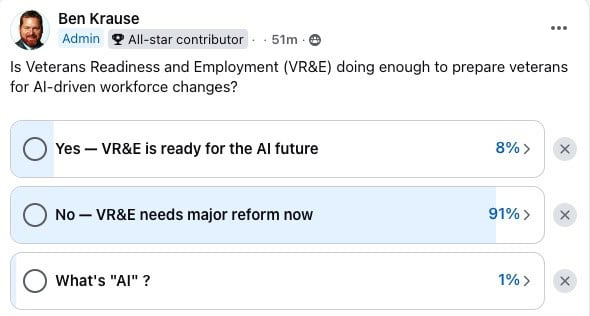
This has become an increasingly important concern within the veteran community. In a poll conducted today, a clear majority of respondents indicated they do not believe VR&E is adequately preparing veterans for AI-related workforce disruption.
JOIN: Our VR&E Facebook Group (Over 40,000 Members)
Their view aligns with a notable gap in the testimony: the lack of any substantive discussion about AI’s impact on veteran employment pathways.
WATCH: HVAC Workforce Hearing 12/02/2025
Hearing Witnesses Represent Industries in Transition
The private-sector witnesses scheduled for tomorrow include leaders from:
- Agricultural equipment manufacturing (Deere)
- Trucking and logistics (Werner / ATA)
- Skilled trades and apprenticeships (Teamsters / Helmets to Hardhats)
- For-profit technical training (UTI)
These sectors employ large numbers of veterans. They are also among the industries undergoing rapid changes due to:
- predictive maintenance
- autonomous systems
- AI-based logistics
- robotics and automation
- electric and hybrid propulsion
- AR/VR diagnostics
These technologies are reshaping job requirements at a pace that traditional workforce planning has struggled to match.
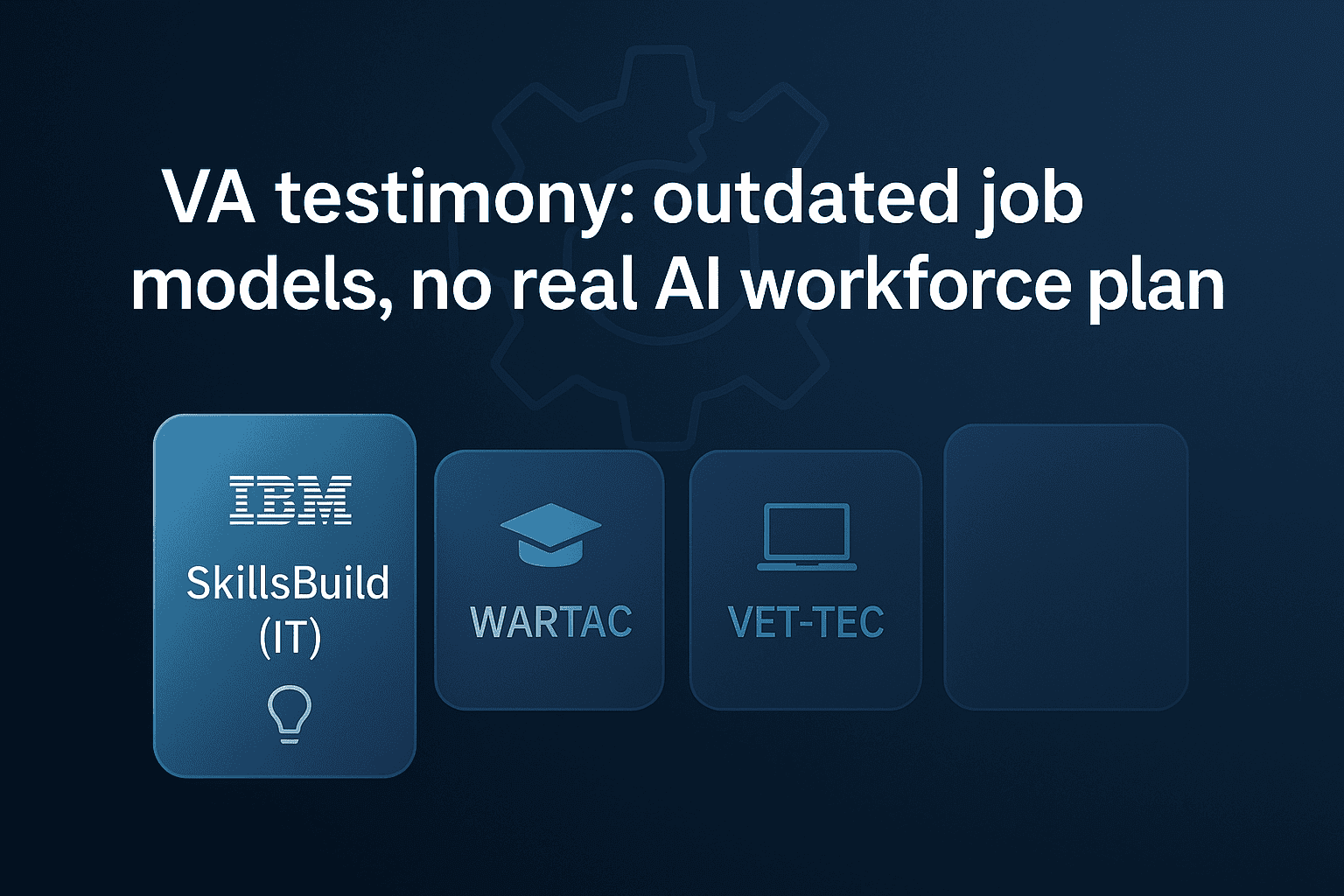
Yet VA’s pre-hearing testimony — including testimony from VR&E and Education Service — mentions Artificial Intelligence only once, and that reference is limited to an IT credential program rather than broad workforce strategy.
SkillBridge Is Highlighted, but Watchdogs Note Structural Issues
VA places significant emphasis on SkillBridge, a DoD program that connects transitioning service members with civilian internships. SkillBridge is valuable and has helped many veterans.
However, recent reports from the Government Accountability Office (GAO) have identified several systemic challenges:
- inconsistent access due to command-level approval
- lack of uniform data on outcomes
- limited tracking of job placement
- varying program quality
- mission-readiness constraints that block participation
These issues do not negate the benefits of SkillBridge, but they do underscore that the program is not, on its own, a sufficient strategy for preparing the entire veteran population for a rapidly changing labor market.
Employer Written Testimony (Pre-Hearing) Highlights the Transition Challenges Veterans Still Face
The testimony submitted by Deere and Werner provides important context about the strengths veterans bring — and the gaps that remain in the transition process.
From John Deere Executive:
“On the surface these employment numbers are impressive, but what they fail to show is the stress, failed starts, and setbacks many transitioning service members face.”
“When Dave Underwood was medically discharged… he faced uncertainty, rejection, and moments of questioning his value outside the uniform.”
Deere also notes that its own military hiring program had to be built around principles of simplicity, employer-supported training, and outcome tracking — because smaller employers often lack the resources to navigate complex government programs.
Their testimony emphasizes that SkillBridge internships have become central to their hiring pipeline, which indicates the program’s usefulness but also raises questions about scalability and consistency across sectors.
From Werner (ATA) Executive:
“The challenges faced by veterans and military families during their transition to civilian life are significant — but solvable.”
Werner stresses the importance of coordinated policy and public-private partnerships, signaling that employers are prepared to support veteran hiring but need alignment from federal agencies.
These employer perspectives highlight both the opportunities and the ongoing challenges veterans face — challenges that require more than access to existing programs.
GI Bill Expansion Alone Does Not Address Future Workforce Needs
The VETS Opportunity Act — expected to be discussed tomorrow — would expand GI Bill eligibility for hybrid and technical programs. This expansion may increase access to training for many veterans.
However, expanding access to training does not resolve the central issue:
VA has not articulated how it will ensure veterans pursue training aligned with long-term labor market trends, including those shaped by AI and automation.
Without updated planning and predictive analysis, there is risk that veterans could exhaust their GI Bill or VR&E benefits preparing for occupations that may decline due to technology-driven changes.
VR&E: A Critical Program Without a Future-of-Work Framework
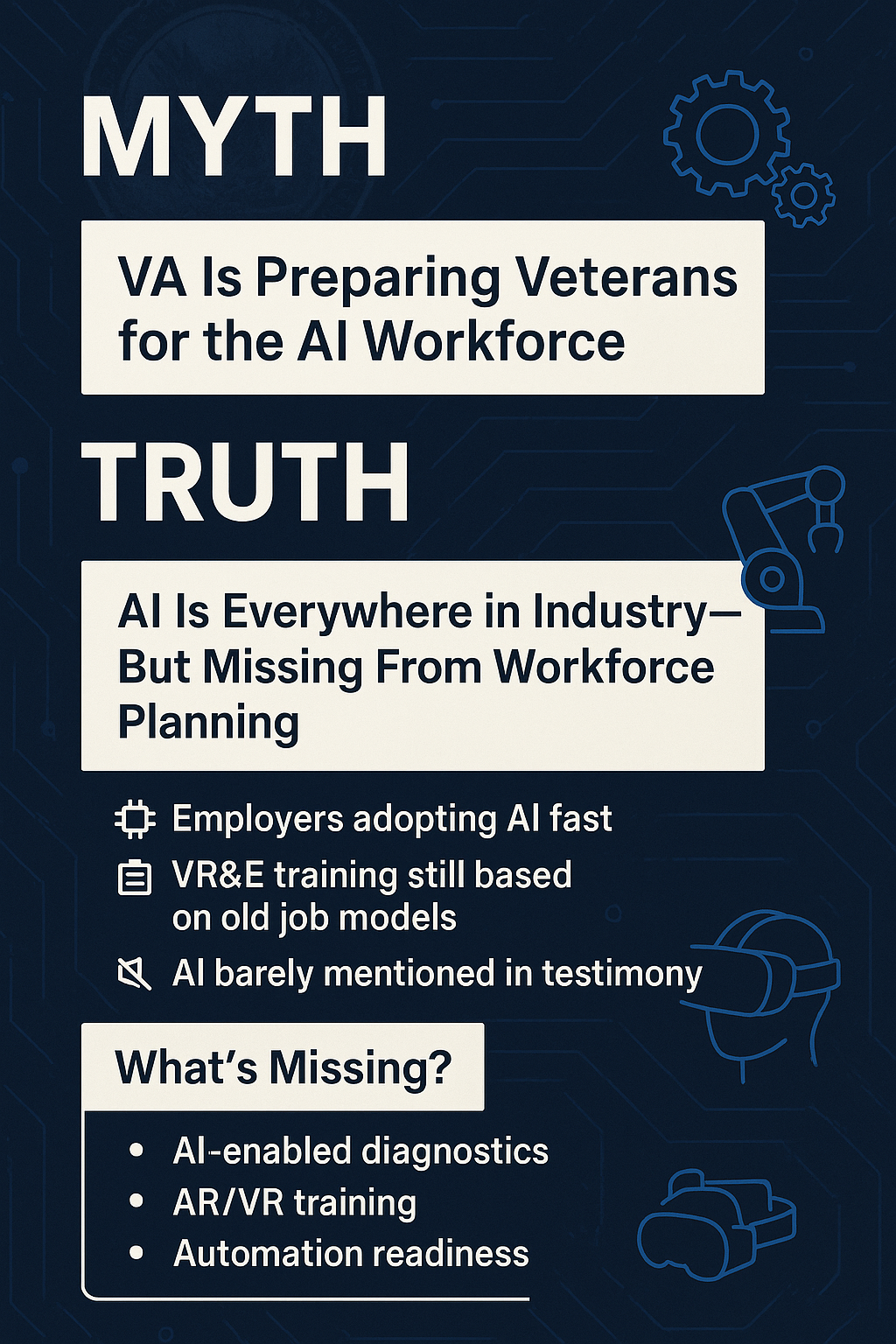
VR&E plays a central role in helping disabled veterans identify, train for, and enter suitable long-term careers. It is the program that most needs an updated workforce framework — yet the pre-hearing testimony does not describe:
- AI or automation risk analysis
- modernized suitability standards
- updates to occupational models
- strategies for retraining veterans displaced by technological shifts
- integration of emerging digital skill pathways
Given the pace of technological change, a forward-looking VR&E strategy is essential to ensure veterans can secure stable, future-ready employment.
An Oversight Opportunity for HVAC
The hearing presents an important opportunity for Members to ask VA:
- How is the agency incorporating AI and automation into workforce planning?
- What steps is VR&E taking to modernize suitability analyses?
- How will VA help veterans avoid training for careers that may decline?
- What mechanisms exist to retrain veterans as technology evolves?
- How will VA measure whether partnerships and programs align with future labor market needs?
These questions are not criticisms — they are necessary components of modern workforce oversight.
Veterans Are Watching
This hearing matters for veterans entering civilian employment today and in the years ahead.
- Watch the hearing tomorrow.
- Follow whether Members raise questions about AI-driven workforce change.
- Share your experiences and concerns — your input helps shape oversight.
The goal is not to diminish VA’s current programs but to ensure they evolve to match the realities of a rapidly changing labor market.
AI and automation are already transforming how work is done in the very sectors represented in this hearing.
Veterans deserve a workforce strategy that reflects that reality.
5 Questions HVAC Members Should Be Asking
1. How is VA incorporating AI and automation trends into VR&E’s suitability determinations and long-term workforce planning?
Veterans cannot be guided into occupations that may be significantly disrupted within 5–10 years. What specific forecasting tools or models is VA using?
2. Why does VA’s testimony contain only a single reference to Artificial Intelligence, despite every employer on the panel describing technology-driven changes in their industries?
Does VR&E or Education Service have an agency-wide AI workforce strategy under development?
3. How will VA ensure that veterans do not exhaust their GI Bill or VR&E benefits preparing for career fields that may shrink due to automation or digital transformation?
Is there a mechanism to re-train displaced veterans?
4. What accountability measures is VA implementing to address GAO’s findings that SkillBridge lacks consistent oversight, outcome tracking, and equitable access across service branches?
Is VA confident in using SkillBridge as a primary workforce pipeline?
5. What steps is VR&E taking to modernize counseling, labor-market analysis, and rehabilitation planning so veterans enter stable, future-ready careers rather than legacy occupations?
Are new counselor tools or updated occupational models being piloted?