
If you think VA will protect the record for you during a Veteran Readiness and Employment (VR&E) meeting, think again.
Inside VA’s system, the rule is simple:
If it isn’t documented, it didn’t happen.
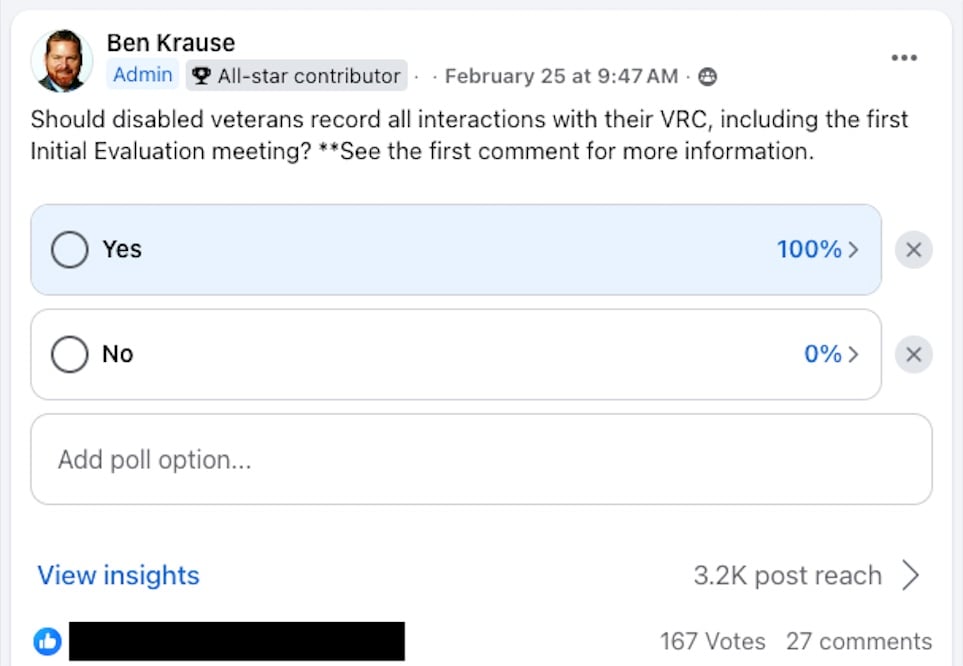
That’s why our community recently ran a poll asking disabled veterans a straightforward question:
Should veterans record all VR&E interactions—including the Initial Evaluation?
The result was unanimous.
100% said yes.
That kind of agreement doesn’t happen by accident. It happens because many veterans have experienced the same pattern:
- Rushed meetings
- Missing notes
- Evidence ignored or mischaracterized
- Decisions that don’t reflect what was actually discussed
Recording—done legally and professionally—can protect your VR&E claim, preserve the truth of the conversation, and create evidence if something goes wrong.
Why Recording VR&E Meetings Matters
Recently, I worked with a veteran (we’ll call her “Jill”) whose VR&E case had already gone through a multi-year appeal.
VR&E had finally recognized her serious employment handicap, which meant the next step should have been vocational counseling and exploration to identify the right career path.
Instead, the counselor attempted to push Jill directly into Rapid Access to Employment without meaningful exploration.
When we asked for basic things—reviewing evidence, explaining labor market data, discussing a psychologist’s opinion—the counselor refused. At one point she admitted she hadn’t reviewed a key medical opinion, then tried to laugh it off.
Eventually, she hung up the call.
Here’s the hard truth veterans learn the hard way: If that conversation isn’t documented, it effectively never happened.
That’s where VR&E recording becomes critical.
Recordings Can Become Evidence
Many veterans assume the recording itself is the evidence. Not exactly.
A raw audio file usually can’t be uploaded directly into the VA’s electronic claims system (VBMS).
But the recording serves an important purpose:
It allows you to create a regular transcript or, better yet, a certified transcript.
That transcript can then be submitted as VR&E evidence showing:
- What was said
- What requests were refused
- What evidence was ignored
- What explanations were never provided
In other words, a transcript turns a chaotic call into documented proof.
The 4-Step Best Practice for Recording VR&E Meetings
If you plan to record interactions with your VR&E counselor, do it professionally and legally.
Follow this protocol.
1. Notify Your Counselor in Writing
Send a brief message before the meeting.
Example:
“For accuracy and note-taking due to my disabilities, I will be recording our VR&E meeting.”
This sets expectations and establishes transparency.
2. Confirm at the Start of the Call
When the meeting begins, calmly restate it:
“Just confirming—I’m recording today for accuracy and note-taking.”
No drama. Just clarity.
3. Record the Entire Session
Do not cherry-pick parts of the meeting.
Record start to finish so the context is preserved.
Partial recordings can create more problems than they solve.
4. Send a Follow-Up Email Within 24 Hours
After the meeting, send a short summary email.
Include:
- What was discussed
- What you requested
- What the counselor said would happen next
End with a simple line:
“If I misunderstood anything, please reply with corrections.”
This email locks the conversation into a written record, giving you a second layer of protection.
You can then attach the transcript to a VA Form 21-4138 and submit it for the record. Most iPhones create a transcript, and you can also pay for a certified transcript from a court reporter.
What If Your VR&E Counselor Says You Can’t Record?
Several years ago, I asked VR&E Service in Washington, D.C. directly whether veterans have the right to record their meetings.
This question came up because some VR&E offices were adding email footers telling veterans not to record calls. These offices are not informing the veterans of their right to record meetings.
VR&E Service ultimately confirmed: Veterans do have the right to record their interactions.
If your counselor objects, the best approach is simple:
- Stay calm
- Ask them to check with VR&E Service for guidance
Often, once leadership verifies the policy, the meeting will be rescheduled and recording will be allowed. If the counselor discontinues the call to check, you can always send an email to be sure you document that he or she refused to proceed.
Important Legal Note
Recording laws vary by state.
- Some states allow one-party consent (only one person on the call needs to know).
- Other states require all parties to consent.
Violating state recording laws can carry serious penalties.
Before recording, verify your state’s consent rules or speak with an attorney familiar with those laws.
This article provides educational information only and is not legal advice.
The Bottom Line
Disabled veterans in our community were clear: 100% support recording VR&E interactions.
Not because veterans want conflict.
But because documentation protects disabled veteran rights, preserves the truth of the process, and can create evidence when the system fails.
If you want to protect your VR&E claim, protect the record.